
Boston Brain Center Case Study: Challenging the Status Quo to Achieve More Than 25% Performance Improvement
When Tamelos began working with Boston Brain Center and CEO Andrea C. Kelliher, the objective was not simply to make incremental improvements. The goal was to understand how the organization could operate more efficiently, increase throughput, strengthen financial performance, and create a foundation for sustainable growth.
The starting point was a simple principle: question everything.
In many organizations, processes develop over time. What may have started as an efficient way of working can gradually become inefficient as the business grows, technology changes, customer expectations evolve, and new opportunities emerge. Processes become habits, and habits can become difficult to challenge.
Tamelos took a deliberately different approach with Boston Brain Center. Almost every aspect of the operation was examined with a critical question in mind:
If we were designing this business today, would we do it this way?
Challenging Established Processes
The engagement involved looking beyond individual problems and examining how the different components of the organization worked together.
Scheduling, capacity, resource utilization, patient throughput, operational workflows, administrative processes and financial performance were considered as interconnected elements rather than isolated issues.
The objective was not to change processes simply for the sake of change. Instead, Tamelos focused on identifying the activities, decisions and processes that had the greatest effect on the organization’s performance.
This meant challenging assumptions that had previously been accepted as part of the normal way of doing business.
Where processes could be simplified, they were reconsidered. Where resources could be utilized more effectively, alternatives were examined. Where bottlenecks were limiting throughput, their underlying causes were investigated.
The result was a broader transformation in the way the organization looked at its own performance.
Increasing Throughput and Improving Financial Performance
One of the central opportunities identified during the engagement was the relationship between operational efficiency and financial performance.
Increasing revenue does not necessarily require simply increasing prices or adding more resources. In many businesses, significant opportunities exist within the existing infrastructure by improving utilization, reducing unnecessary inefficiencies and enabling the organization to handle more activity effectively.
For Boston Brain Center, the focus was therefore on doing more with the resources already available while improving the way those resources were deployed.
By examining workflows and challenging established methods, the organization was able to identify opportunities to increase throughput and improve the overall economics of its operation.
The engagement ultimately contributed to more than 25% improvement in overall performance, demonstrating the potential impact of systematic operational and financial analysis.
Importantly, this was not based on one isolated change. The improvement came from examining the business as a whole and identifying multiple opportunities where relatively small changes could collectively produce a substantial result.
Making Better Use of Advanced Rehabilitation Technology
Boston Brain Center operates in a specialized neurological rehabilitation environment, where the effective use of technology and clinical resources is an important part of its service offering.
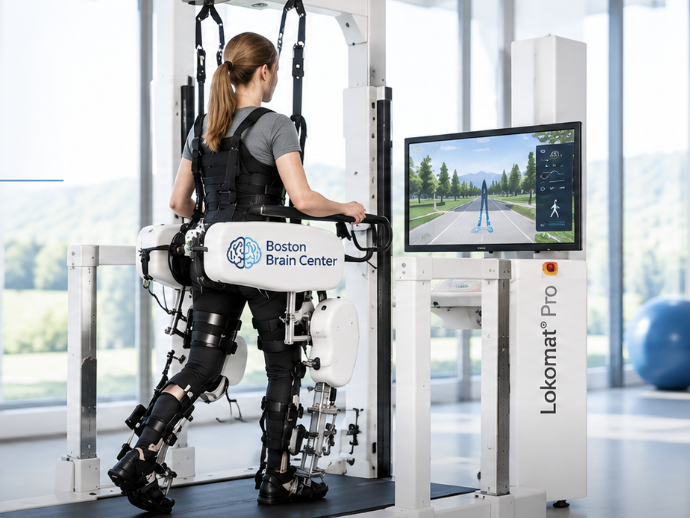
One of the organization’s flagship technologies is the Lokomat Pro, an advanced robotic gait-training system used as part of neurological rehabilitation.
The Lokomat combines a treadmill, robotic leg supports, adjustable body-weight support and robotic guidance to provide controlled, repetitive walking practice. Boston Brain Center’s therapists can adjust the level of assistance, walking speed, body-weight support and other parameters according to the individual patient’s abilities and rehabilitation goals.
For a business operating sophisticated rehabilitation technology, the equipment itself represents only part of the opportunity. The real question is how effectively the organization can integrate that technology into its overall operation.
Tamelos therefore considered not only the technology and its capabilities, but also the operational processes surrounding its use — including scheduling, capacity, utilization, throughput and the relationship between available resources and patient demand.
You can learn more about the technology and Boston Brain Center’s approach to robotic gait rehabilitation on its Lokomat Pro therapy page.
Turning Complexity Into Opportunity
The Boston Brain Center engagement demonstrated an important principle of performance improvement: the biggest opportunities are not always immediately visible.
A business can have talented people, advanced technology and strong demand while still leaving significant performance potential unrealized.
Often, the limiting factor is the way those resources are organized and connected.
By stepping back from the day-to-day operation and examining the business from an independent perspective, Tamelos was able to challenge established assumptions and identify opportunities that were difficult to see from within the organization.
The emphasis was on practical improvement rather than theoretical recommendations.
The objective was to determine:
- Where was capacity being lost?
- Which processes were creating unnecessary friction?
- How could throughput be increased?
- Were existing resources being fully utilized?
- Which activities contributed directly to financial performance?
- Where could processes be simplified?
- Which assumptions about the way the business operated needed to be challenged?
These questions helped create a more performance-oriented approach to running the organization.
A Partnership Focused on Results
For Andrea C. Kelliher and the Boston Brain Center leadership team, the value of the engagement went beyond individual recommendations.
It created a different way of looking at the business.
“Working with Tamelos gave us a completely different perspective on our organization. They were willing to challenge the way we had always done things and, importantly, they didn’t just identify problems — they worked with us to find practical solutions.
What I appreciated most was their ability to look at both the operational and financial sides of the business. They asked difficult questions, challenged assumptions and helped us see opportunities that we might otherwise have overlooked.
The improvements in throughput and overall performance made a meaningful difference to our organization. Tamelos was a true partner throughout the process, and we greatly appreciated their commitment to helping us improve.”
More Than a 25% Improvement
The results of the engagement illustrate what can happen when an organization is prepared to challenge its established way of working.
For Boston Brain Center, the work contributed to more than 25% improvement in overall performance, increased throughput and improved financial performance.
The achievement was not based on a single dramatic intervention. It came from systematically examining the business, questioning existing processes and finding opportunities to make better use of the organization’s people, technology, capacity and resources.
That is the essence of the Tamelos approach to business consulting.
We don’t begin with the assumption that the existing way of doing things is the right way. We begin by asking why things are done that way — and whether there is a better alternative.
Creating Long-Term Performance Improvement
Sustainable improvement requires more than identifying inefficiencies. Organizations need processes and decision-making frameworks that allow improvements to continue after the initial consulting engagement has ended.
That is why Tamelos focuses on building practical improvements that become part of the way an organization operates.
The Boston Brain Center engagement is an example of this approach in action: an established organization with specialized capabilities, experienced professionals and advanced technology examined from a fresh perspective.
The result was a stronger understanding of where performance could be improved, greater throughput, improved financial performance and more than 25% overall performance improvement.
For organizations facing increasing competition, growing operational complexity or pressure to improve financial performance, the lesson is straightforward:
Don’t assume that the way you have always done things is the way you should continue doing them.
Sometimes the greatest opportunity for growth is already inside the business.
You simply need to challenge everything, find it and act on it.
To learn more about Boston Brain Center and its neurological rehabilitation services, visit the organization’s website.